GCSE
LCM & HCF
These are both properties of a set of numbers.
Lowest Common Multiple
Process
- Take the first number and create a factor tree.
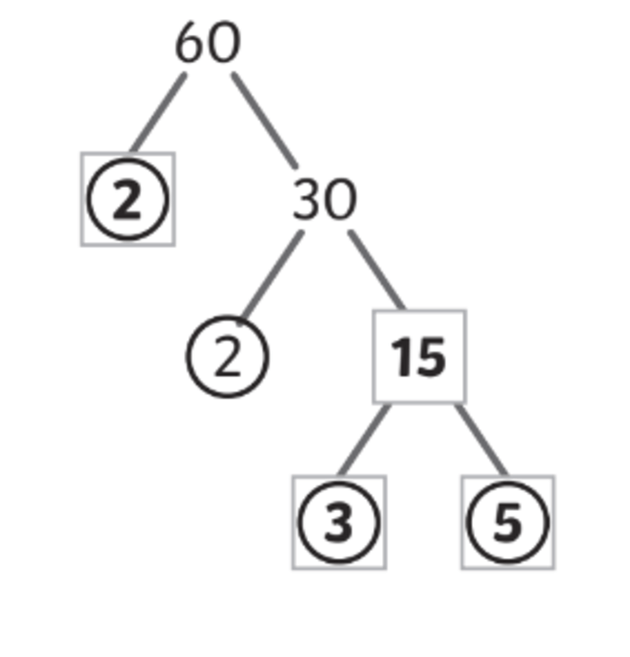
- Draw two legs from the number
- Start from the lowest prime and try to divide the number
- If the number divides cicle the prime and write the new number on the other branch
- If they don't divide then move up to the next prime and try again.
- Continue until you can no longer divide and you are left with primes.
- Do the same to the next number (repeat for all).
- Pull out the most of each number present in each tree. i.e. if 12 factors has 2 2s then taken them because 15 has none. If they have the same amount then just take one set.
- Multiply all numbers together and this is the lowest common factor.
Examples
- Prime factors
12
| \
2  6
   | \
   2  3

15
| \
3  5
- Combine one instance of each term from both.
- Multiply them all together
Why does this work?
This reddit post does the best job I found at explaining why this work.
In short, prime factorization of 12 is 2² * 3 and prime factorization of 18 is 2 * 3². In order for some number p to be a multiple of 12, p must have at least 2 twos and at least 1 three. In order for p to be a multiple of 18, it must have at least 1 two and at least 2 threes. So, for p to be a multiple of both, it must fulfill all of those conditions. However, if p has 2 twos, it therefore also has 1 two, so it fills both of the conditions regarding the number 2. Same goes for p having 2 threes. That's why you choose the largest exponent among the prime factors.
For HCF if two number are to have a common multiple they must contain all of the primes of both numbers, so by decomposing each number, you can collect common and uncommon terms without extra and create that first common multiple.
Highest Common Factor
The greatest factor which will divide into each numbers.
What is a factor?
A factor is a whole number which will divide into another number without a remainder.
Process - Listing method
- List all the factors of each number.
- Compare each list and find the highest number which appears in both.
Example - Listing method
- All numbers listed
- Found the highest common factor
Process - Prime factor method
- Find the prime factors of each number using a tree.
- Multply together the prime factors of one number which are present in the other number.
Example - Prime factor method
- Prime factor tree
30
| \
2  15
   | \
   3  5

20
| \
2  10
   | \
   2  5
- Multiple the common factors.
Numbers are Prime
If all numbers are prime then the highest commmon factors they share are 1 because the definition of a prime is that it's only factors are 1 and itself.
If one number is prime and that number is larger than the rest then the hcf will be 1.
If one number is prime and that number is smaller than the others then the hcf can be that number if it exists in the prime factors of the other numbers. If it does not exist in the prime factors of the other numbers then the hcf is 1.
Why does this work?
A property of two numbers is that if they share prime factors, the the product of those factors will equal a number which is divisible into both without remainder. This is simply a trick to finding that.
Expanding and Factorizing
Expanding
Expanding is when you multiply each term in the bracket by the expression outside the brackets.
A term is a single number, a variable or an expression.
There are several types of expansions. Linear brackets . Expansion of adjacent brackets .
Method - Foil
This method is called Foil, it's an acronym.
- First
- Outside
- Inside
- Last
Its a way of organizing your multiplications of each term within each expression without losing track.
Worked Example - Linear brackets
can be expanded easily because the number we are expanding with is a simple small integer.
We can start with the left side.
That was the result of two operations...
Then there is the right side.
That was the result of two operations...
This is fully expanded but we can simplify
Finally we can put these both together.
This is also the result of two operations where we combine the like terms.
Finally we put the non-like terms next to each other because they cannot be simplified any more.
Worked Example - Adjacent brackets
Smiley face method. Named because of how it is drawn.
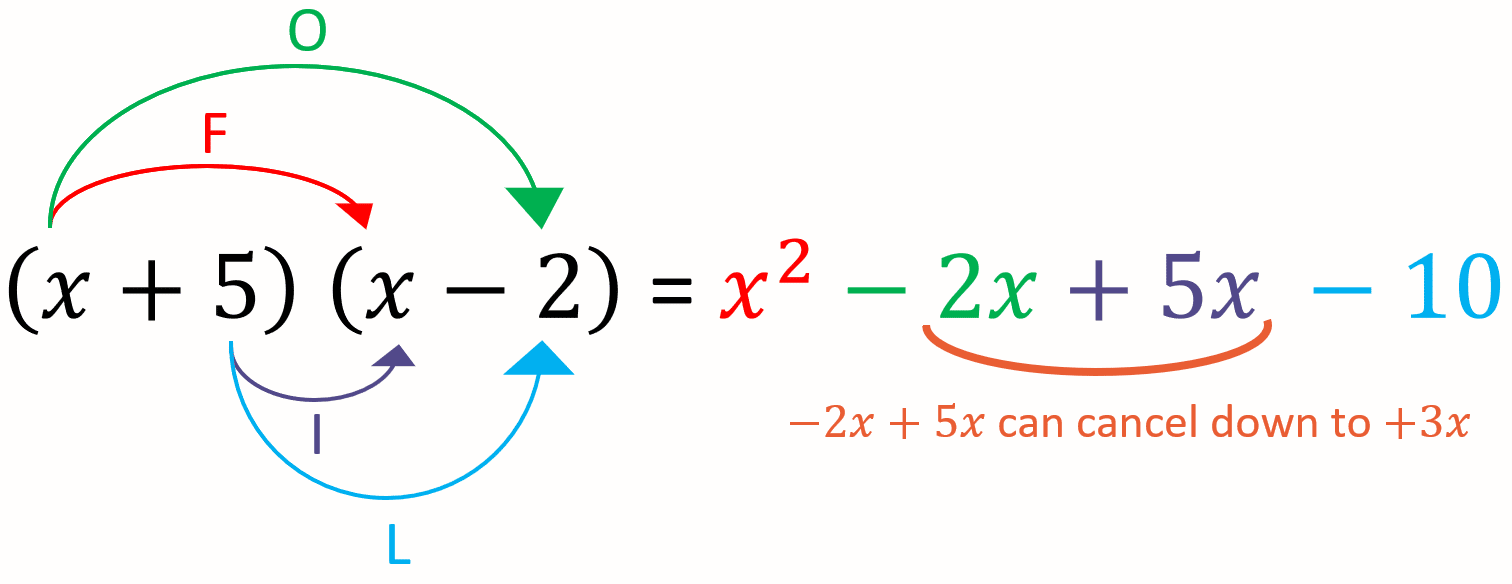
In the same way we multiply each term inside the expression by each term in the adjacent expression.
Simplify
Why does this work?
This is the distributive property. It says that multiplying a sum by a number is the same as multiplying each term within that sum.
How does it relate?
It allows us to remove the parenthesis from an expression.
Factorizing
To factorize is to decompose an expression into a product of another expression. We do this using brackets. It is the opposite of expansion.
Worked Example
- Look for common parts in each section of the expression.
- they both have a 3
- they both have a y
- this would be as and
- this would be as and
Putting it all together
Factorizing Quadratics
If one of the terms in the expression is squared then we have a quadratic.
If it's a quadratic then we know that there will always be two sets of brackets.
Find the factors of the number which is not adjacent to an x.
10
| \
1  10
2  5 BINGO!
This will give you the two x numbers.
will give you
will give you the and the .
Factorizing quadratics with negatives
- When one number is negative and one number is positive.
If the numbers you are looking for add to a negative number*x and multiply to a positive number. Then they have to be both negative.
If you are looking for two numbers which create then they have to be negative. Start by factorizing 8.
 8
 | \
-1  -8 BINGO!
- When both numbers are negative.
In this situation one of the numbers needs to be negative and one needs to be positive.
 10
 | \
-1  10
 1 -10
-2  5
 2 -5
This should be clearer
Factorizing - the difference of two squares
This is when you have something like
It can be factorized by remembering that the two x numbers in the middle cancelled each other out. What you are left with is a square number.
Check that they are both squares and you can use the difference of two squares technique.
Why does this work?
This is also utilizing the distributive property of expressions. You can find common factors and create brackets to show that the factors multiplies by the contents of an expression is the factorized form of an expression.
How does it relate?
It is the exact opposite of expansion.
Simultaneous Equations - Elimination
Method with elimination - subtraction
- subtract the first terms from each other
- subtract the second terms from each other
- subtract the equation results from each other
- the final equation after subtractions
- Choose what you think will be the easiest equation to substitute 4 into as
xand work out the equation - take 2 from both sides
Method with elimination - addition
If two terms will cancel out with addition like then we use the addition method.
- add first terms
- add second terms
- add the results
- then rearrange
- sub in the x value into the simplest equation
Method with elimination - aligning the equations so you can either add or subtract
If both of the equations don't line up nicely like the examples above then you need to perform an operation to one of them so that the equations can be easily added or subtracted.
A way to remember this:
- Signs same subtract
- Signs different add
Simultaneous Equations - Substitution
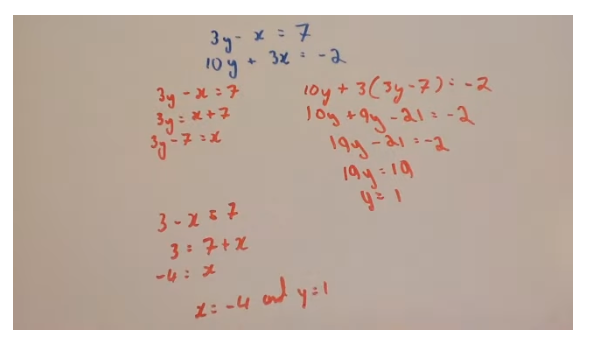
Using corbett maths video to learn this
- Make one of the variables the subject
- The equation which equals the new subject should be substituted into the other equation where the subject exists
- Then expand the brackets
- Evaluate this to find the value of one of the variables
- Take that variable and solve the equation for the other variable
Changing the Subject (Rearranging Formula)
- the subject is the variable is on it's own on one side of a formula
Quadratic Inequalities - By factorizing
Below 0
If y is less than 0 then the curve's minimum will fall below the x axis.
Because this inequality is less than 0 it means we are being asked to provide all possible values for x which make y less than 0.
What we are going to do is find the points which cross the x axis (roots)
In order to do this we need to:
- Factorize the equation for it to be equal to 0
- The parts of the quadratic which describe x and aren't the square are the roots
- Check your answer by going backwards
- If you want to test these you can plumb your two x values into the equation and you should get 0
Above 0
We know that any value between -2 and 3 is negative, so we can say that part of the answer is:
We also know that any value of x that is less than -2 will be positive:
Finally we put the above together and say:
If they are equal to or greater than 0
Complex example
1. Put all the x's on one side
2. Factorize and remember to things about the multiplier on the square number
3. Continue to factorize
4. Find the y values where x is equal to 0
Quadratics - Completing the Square
This is useful for finding the minimum and maximum of a quadratic graph.
Factorizing the left hand side to get a quadratic
Completing the Square
- Because it's you put an x in the first bracket. Then square the brackets.
- Now look at the number in the bracket of the quadratic and half it. Put that halved number into the new equation.
- Now take away the previous number from the last step. Take it away from the whole equation.
- The final part of the equation needs to be put on the end.
- Finally you can simplify.
Finding the Roots
- Move the free number to the right hand side.
- Square root both sides.
- Move the other number to the right hand side.
- Find the roots.
Which parts of this solutions give you features of a curve
Once you've put the quadratic into the form you have the turning point of the curve. It is .
Once you've completed the square, you have the roots.